info@sandmancrusher.com
+86 150 9289 4665

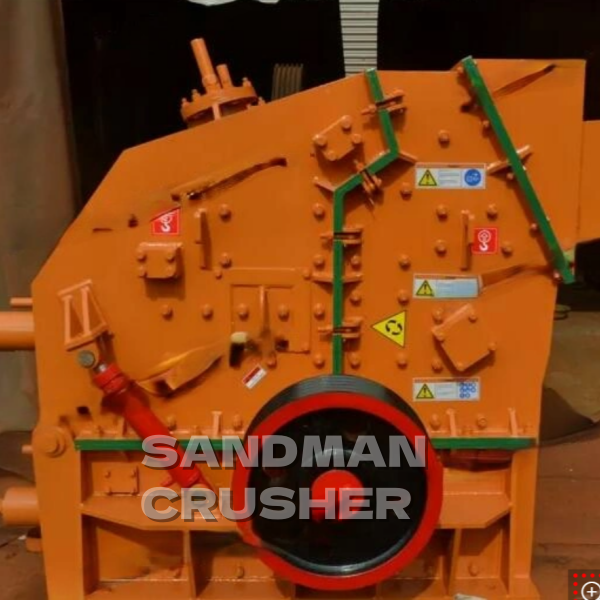
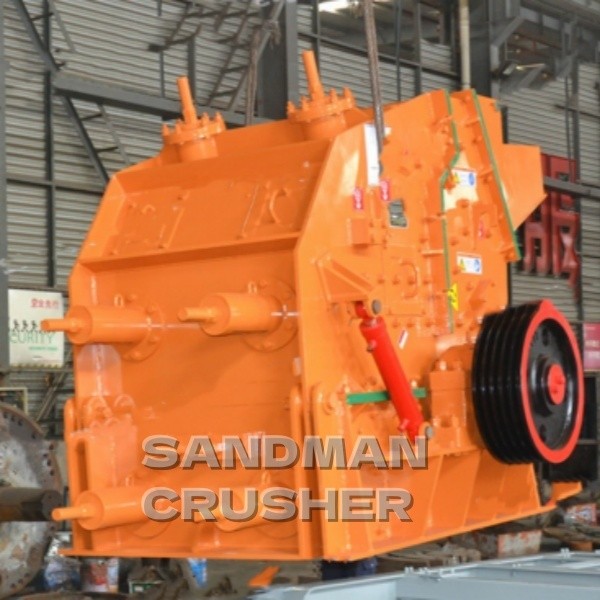
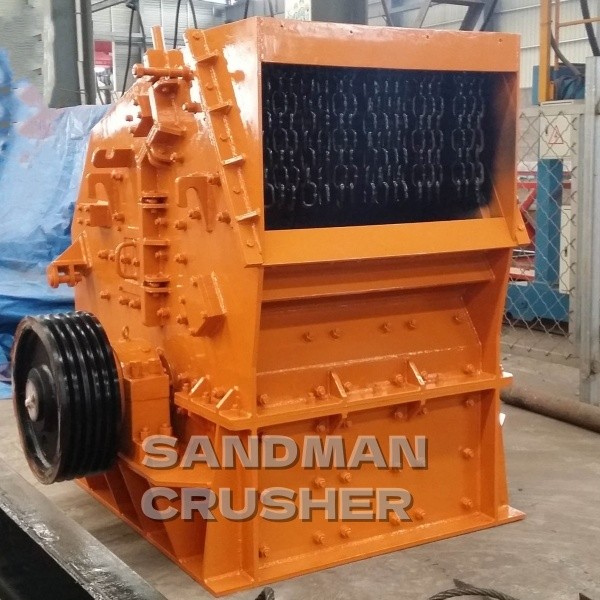
The horizontal impact crusher (often simply referred to as an impact crusher) is a primary piece of equipment for secondary and tertiary crushing operations.
Unlike equipment that relies on compression or grinding forces, this machine operates entirely using impact energy. It is widely used in sectors such as mining, metallurgy, highway and railway construction, water conservancy projects, and concrete aggregate processing.
What is a horizontal impact crusher?
The horizontal impact crusher (often simply referred to as an impact crusher) is a primary piece of equipment for secondary and tertiary crushing operations.
Unlike equipment that relies on compression or grinding forces, this machine operates entirely using impact energy. It is widely used in sectors such as mining, metallurgy, highway and railway construction, water conservancy projects, and concrete aggregate processing.
How does a horizontal impact crusher work?
Raw material enters the crushing chamber from the top. As the rotor spins at high speed, the blow bars mounted on it strike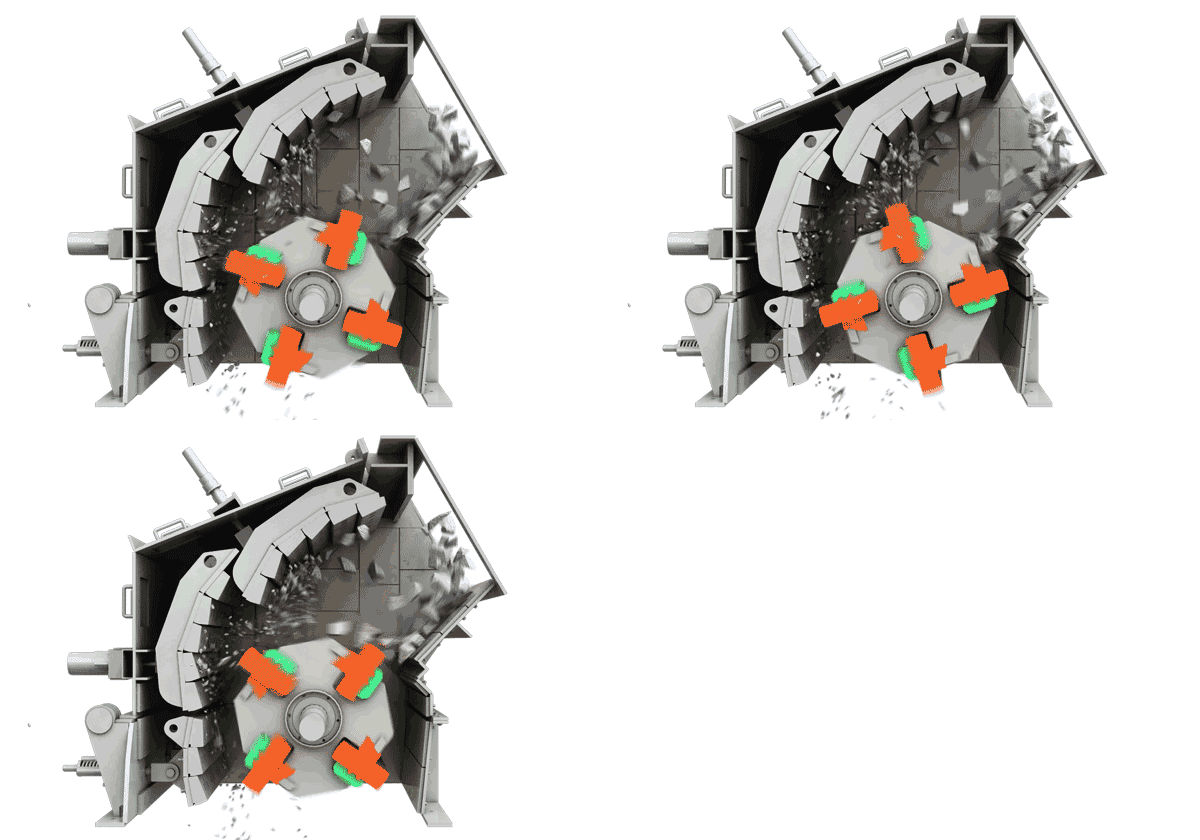
the falling stone with great force. This instantaneous impact imparts immense kinetic energy to the stone, propelling it at high speed against the impact plates, which are positioned at fixed angles within the chamber.
This secondary collision further breaks down the material. Large pieces of stone rebound from the impact plates back into the rotor's working zone, colliding with newly entering material. This creates a continuous cycle of inter-particle collisions and self-grinding, resulting in highly efficient crushing.
This impact-based crushing method is ideally suited for brittle materials such as limestone, bluestone, and construction waste. For medium-hard rock with a compressive strength of less than 300 MPa, impact crushers offer superior crushing efficiency and lower energy consumption per unit of finished product.
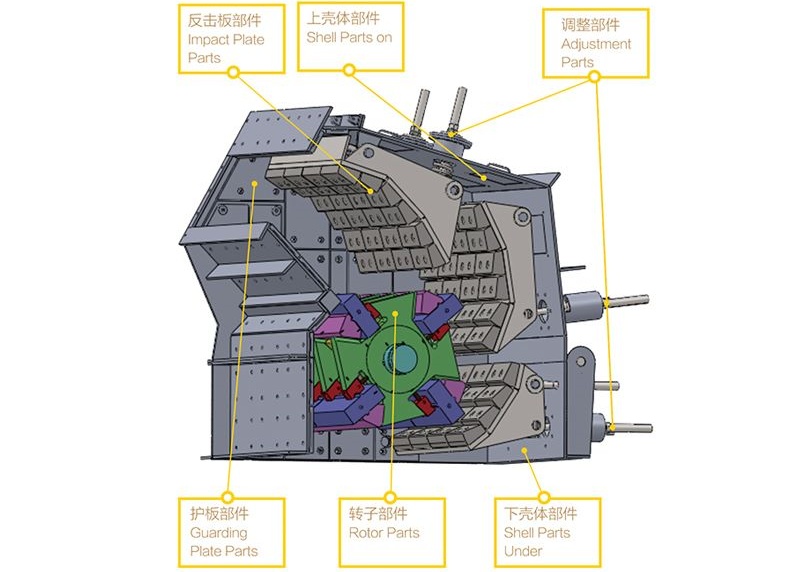
What is Core Components of the horizontal impact crusher?
Each key component plays an indispensable role in the stable operation of the machine and possesses unique functional characteristics:
Rotor Assembly: The core power component of the machine. During prolonged operation, it withstands continuous impact forces and alternating loads. The rotor surface features dovetail slots to secure the blow bars, which are fastened using anti-loosening alloy bolts.
Blow Bars: The most wear-prone components of the horizontal impact crusher; they require regular inspection and replacement during routine maintenance.
Frame: The main load-bearing structure of the machine. Small crushers utilize a single-piece cast frame to ensure overall rigidity, whereas large models employ a split-welded frame made of thick steel plate. The upper frame is designed to open, greatly simplifying internal maintenance. All welds undergo rigorous flaw detection, and rubber vibration-isolation pads at the base minimize the transmission of vibration and noise to the foundation.
What is Key Advantages of the Horizontal Impact Crusher?
This equipment stands out in practical operations due to the following unique advantages:
1. Excellent Aggregate Shape
Utilizing impact crushing and inter-particle attrition, the machine produces aggregates that are predominantly cubic with smooth, flat surfaces. The content of elongated and flaky particles is extremely low; high-performance models can keep the flaky particle content below 5%, fully meeting the rigorous standards for aggregates in high-grade infrastructure construction.
2. Strong Material Adaptability
It is capable of processing a wide range of materials, including common stones such as limestone, bluestone, basalt, granite, and river pebbles, as well as industrial and construction waste like iron ore, waste concrete, and asphalt mixtures.
By simply adjusting the gap between the impact plates and the rotor, the output particle size can be flexibly controlled...Particle size range: 0–80 mm.
3. Simple structure, easy maintenance
The internal structure features few precision components, resulting in a low failure rate. A hydraulic quick-opening top cover allows rapid access to the crushing chamber, enabling quick and convenient replacement of hammer bars, liners, and impact plates without dismantling other parts. All spare parts are standardized, effectively reducing inventory costs for the enterprise.
4. Low comprehensive operating costs
Although hammer bars are wear parts, overall energy consumption is far lower than that of compression-based crushing equipment. For the same production capacity, energy consumption per ton of finished product is 15%–25% lower than that of cone crushers.
The impact crushing method enables rapid material breakage, avoiding energy waste caused by ineffective friction and prolonged compression. Additionally, a self-lining protection structure extends the service life of the liners; the standard replacement interval is approximately once every six months.
5. Excellent environmental performance
Modern horizontal impact crushers feature fully sealed dust covers at the feed, discharge, and crushing zones. These can be paired with pulse-jet bag dust collectors to effectively control dust pollution. Equipped with sound-insulating materials and damping pads, the equipment keeps operating noise below 85 decibels, meeting on-site environmental standards.
What is Limitations of horizontal impact crusher?
No single piece of equipment is a universal solution; impact crushers also have certain operational limitations.
Feed particle size must strictly adhere to the equipment's design parameters. Processing ultra-hard or highly abrasive materials significantly accelerates wear on consumable parts. Improper equipment selection can lead to low production efficiency, excessive spare part consumption, and an overabundance of fine powder waste.
Therefore, the production line must be configured appropriately based on actual material characteristics and production goals. We can provide professional guidance on equipment selection if needed.
Technical Parameters
| Model | Feed size(mm) | Max.feeding(mm) | Capacity(t/h) | Power(kw) | Weight(t) | Dimensions(mm) |
| PF0607 | 320x770 | ≤100 | 10-20 | 30 | 4.5 | 1500*1450*1500 |
| PF0810 | 400 x 980 | ≤250 | 20-60 | 45 | 9.5 | 1975*1890*1645 |
| PF1010 | 400 x 1080 | ≤300 | 50-90 | 55 | 12.8 | 2330*2010*2560 |
| PF1210 | 450 x 1060 | ≤300 | 60-130 | 90 | 14 | 2640*2010*2850 |
| PF1214 | 450 x 1440 | ≤300 | 100-200 | 132 | 19 | 2640*2400*2850 |
| PF1315 | 550 x 1530 | ≤350 | 130-280 | 160 | 24 | 2930*2670*3150 |
Note: Technical data are subject to change without prior notice.
Standard operation and maintenance guidelines for horizontal impact crusher
Standardized operation and regular maintenance are key to the equipment's long-term, stable performance.
Startup procedures
Before starting the machine, conduct a comprehensive inspection of all wear parts, fastening bolts, lubricating oil levels, dust seals, and iron removal devices. Clear any residual material or foreign objects from the crushing chamber.
The equipment must be started under no-load conditions. Allow the motor to idle for 3 to 5 minutes to check for abnormal vibration, noise, or oil leaks before gradually introducing feed material.
Production process management for horizontal impact crusher
Maintain a uniform and stable feeding rate. Avoid sudden, massive feed intake to prevent rotor overload. Feed particle size must remain within the equipment's rated range; oversized material is strictly prohibited from entering the crushing chamber.
During operation, if abnormal motor noise, excessive vibration, or a sudden current surge is detected, stop feeding immediately. Allow the material inside to be fully crushed and discharged before shutting down the main motor to prevent chamber blockage.
Daily Shutdown Procedure
First, stop the feed and let the crusher run for approximately 5 minutes to completely clear residual material from the crushing chamber, then cut off the power supply.
Routine Maintenance Schedule
Daily Maintenance
Check the tightness of hammer bolts; inspect wear on liner plates and impact plates; monitor bearing temperatures and oil circuit conditions; clean dust collector filter bags.
Weekly Maintenance
Tighten all frame and rotor mounting bolts; measure hammer thickness and promptly replace unevenly worn parts to ensure rotor dynamic balance; clear debris from the bottom of the crushing chamber; check and adjust V-belt tension.
Monthly Maintenance
Perform rotor dynamic balance testing; re-lubricate bearings; inspect adjustment screws and hydraulic seals, and repair damaged dust seals; test the performance of the iron-removal magnet.
Annual Maintenance
Dismantle the rotor to inspect for cracks and deformation; replace all severely worn liner plates and impact plates; check bearing clearance and replace bearings if necessary; weld and repair frame cracks; apply a comprehensive anti-rust coating.
Common Faults and Solutions for horizontal impact crusher
1. Severe Equipment Vibration
Primary causes: Rotor imbalance (uneven wear on impact bars), loose mounting bolts, aging vibration-damping rubber pads, or foreign metal objects inside the chamber. Solutions: Replace impact bars in pairs, tighten all mounting bolts, replace aged rubber pads, and clear out foreign objects.foreign matter.
2. Abnormal loud impact noise
Main causes: foreign hard objects in the chamber, loose impact plates, or friction between blow bars and lining plates. Solutions: stop feeding immediately, empty the chamber, open the upper cover to remove foreign matter, and fasten all loose parts.
3. Overheated bearings
Main causes: insufficient lubricating grease, blocked oil pipelines, excessive bearing clearance, or long-term unbalanced load operation. Solutions: replenish lubricating grease, clean blocked pipelines, replace faulty bearings, and re-calibrate rotor balance.
4. Low output and excessively coarse materials
Main causes: overly large rotor-impact plate gap, severely worn blow bars, or uneven feeding. Solutions: appropriately reduce the discharge gap, replace worn blow bars, and adjust the feeder to ensure uniform feeding.
5.Excessively high motor current
Main causes: overfeeding leading to chamber blockage, bearing seizure, or power phase loss. Solutions: cut off feeding, clear internal blockage, repair faulty bearings, and check the power supply circuit.
Industry Development Prospect
Driven by green mining policies and the circular economy, the application prospect of horizontal impact crushers is becoming increasingly broad.
Urban renovation and road upgrading produce a huge amount of construction waste every year. Mobile horizontal impact crushers can realize on-site crushing and recycling of these wastes, turning waste concrete and masonry into recycled aggregates for road base paving and eco-friendly brick production. Many regions also offer policy subsidies for construction waste recycling projects, further boosting market demand for mobile impact crushing equipment.
Meanwhile, the equipment is constantly upgrading and iterating. New rotor structures and high-performance alloy materials effectively reduce energy consumption and extend the service life of wearable parts.
Intelligent monitoring systems can realize early fault warning and reduce manual inspection workload, moving production towards unmanned and intelligent operation. Hydraulic quick-opening structures, automatic lubrication devices and integrated dust removal systems have become standard configurations, making horizontal impact crushers more energy-saving, environmentally friendly and efficient.
Contact: Hebe Wang
Phone: +86 150 9289 4665
Tel: +86 150 9289 4665
Email: info@sandmancrusher.com
Add: No.23 Yihe Road,Linyi City, Shandong Province, China
We chat